Dog’s we love Secret of The Lost Pleistocene Wolf
Introduction: The Forgotten Wolf That Started It All
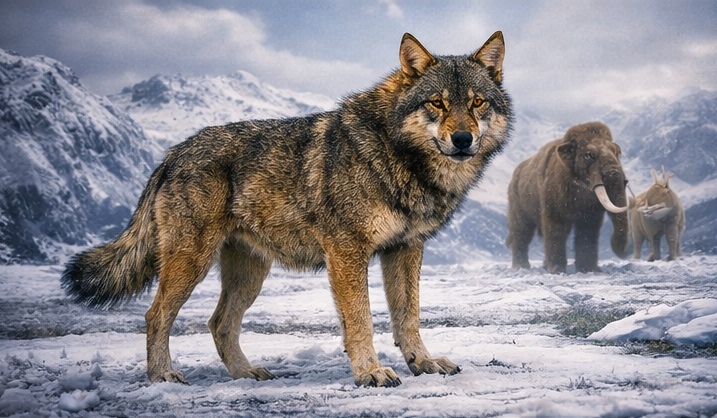
In the frozen silence of the Ice Age, an ancient wolf roamed the Eurasian tundra — a powerful hunter and the unlikely architect of one of humanity’s most enduring partnerships. This predator, known today as the Pleistocene Wolf, no longer walks the Earth, yet its legacy lives on in every domesticated dog.
Picture the world 30,000 years ago: glaciers stretched across continents, mammoths trudged through snow, and humans huddled around fires for warmth. In this harsh landscape, survival depended on endurance, cooperation, and adaptability. The Pleistocene Wolf embodied all three. Larger and stronger than most modern wolves, it was built to chase prey across endless tundra, relying on stamina rather than speed alone.
Long before cities, agriculture, or written history, humans shared these icy landscapes with packs of formidable wolves. Among them, one lineage gradually formed a remarkable relationship with early humans. Instead of competing, they began to coexist — wolves scavenging near camps, humans tolerating their presence. Over thousands of years, this fragile truce transformed both species forever.
Scientists believe modern dogs diverged from this extinct wolf population between 27,000 and 40,000 years ago. Diverged simply means the family tree split: one branch became dogs, the other remained wolves. Every dog — from tireless working breeds to beloved companions — carries the genetic memory of a wolf that vanished from the wild millennia ago.
In many ways, every bark, wagging tail, and loyal gaze today is a living echo of the Pleistocene Wolf — a species whose body disappeared but whose DNA survives in loyalty, intelligence, and companionship.
Origins & History: The Ice Age Hunter
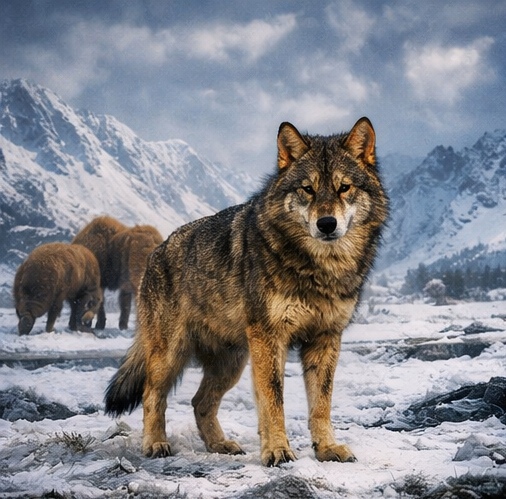
The saga of the Pleistocene Wolf unfolds during the Pleistocene Epoch, a vast stretch of time lasting from about 2.6 million to 11,700 years ago. This was the age of ice and giants, when massive glaciers sculpted the Northern Hemisphere and tundras stretched for thousands of kilometers. In these frozen landscapes, resilient megafauna thrived — creatures so large they seemed almost mythical.
Breaking it down: “Megafauna” simply means “large animals.” Think of mammoths with shaggy coats, bison the size of trucks, and reindeer herds sweeping across the plains. These giants were the lifeblood of the Ice Age ecosystem, and the Pleistocene Wolf was one of its most formidable predators.
Unlike saber‑toothed cats, which relied on ambush and explosive power, wolves specialized in endurance hunting. They were built not for short bursts but for stamina — capable of tracking prey for hours, even days, until exhaustion set in. This strategy required teamwork. Packs coordinated silently, using communication and persistence to wear down animals far larger than themselves.
Archaeological evidence suggests that humans and wolves often crossed paths during these hunts. Cave art in places like Chauvet, France, and Altamira, Spain, depicts wolves alongside human figures. These images hint at a remarkable truth: even before domestication, humans recognized wolves as fellow hunters of the Ice Age.
Fun Fact
Genetic research places the divergence of dogs from the Pleistocene Wolf between 27,000 and 40,000 years ago. That makes dogs among the oldest domesticated companions in human history — older than horses, cattle, or even cats.
Physical Traits: Built for Survival
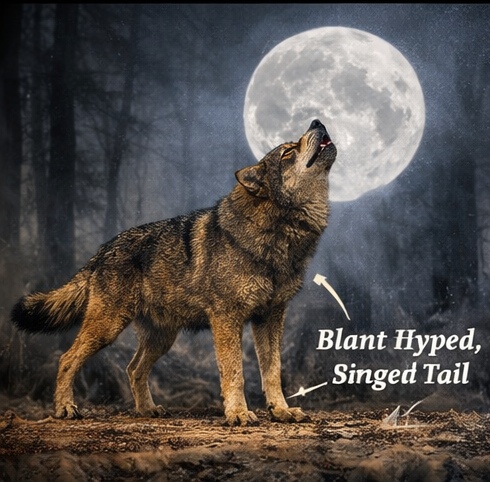
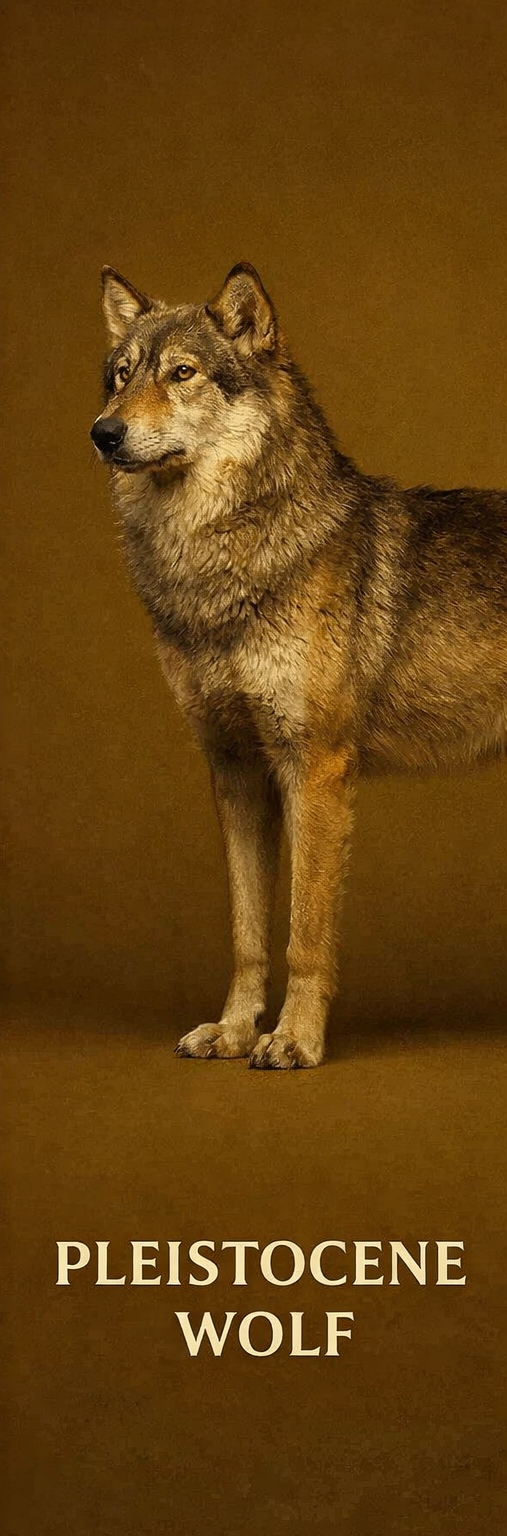
Though fossil records are limited, scientists have pieced together the likely appearance of the Pleistocene Wolf through skeletal remains and genetic clues. What emerges is the image of a predator larger, stronger, and more resilient than most modern wolves — a creature fine‑tuned for survival in the brutal Ice Age.
Size and Build
The Pleistocene Wolf stood tall, with a shoulder height comparable to or even greater than today’s Gray Wolf. Weighing between 40–60 kilograms (90–130 pounds), it was built for power and endurance. Its long legs were not designed for short sprints but for stamina, allowing it to cover vast distances across open tundra in pursuit of prey. This endurance running was its greatest weapon, enabling it to wear down animals far larger than itself.
Coat and Cold Resistance
To withstand temperatures that often plunged below freezing, the wolf’s coat was likely dense and layered, similar to that of Arctic wolves today. This insulating fur acted as natural armor against icy winds and snowstorms, keeping the animal warm while it prowled the frozen plains. In the Ice Age, survival wasn’t just about strength — it was about resisting the cold, and the Pleistocene Wolf was perfectly adapted to do so.
Jaws and Bite Force
Its skulls reveal robust jaws capable of crushing bones. Scientists estimate its bite force at 400–500 PSI (pounds per square inch). To put that into perspective: a domestic dog averages around 230 PSI, while a hyena can reach over 1,000 PSI. The Pleistocene Wolf sat firmly in the middle, strong enough to crack through the bones of mammoths and bison to reach nutrient‑rich marrow — a vital survival strategy in lean times.
Speed and Endurance
While not the fastest predator of the Ice Age, the wolf could reach bursts of up to 60 km/h (37 mph) when needed. More importantly, it excelled at sustained pursuit, maintaining a steady pace of 8–10 km/h for hours. This endurance hunting allowed packs to exhaust prey like bison or reindeer, forcing them to collapse from fatigue before the wolves closed in for the kill. Unlike cats, which relied on stealth and sudden ambush, wolves were marathon runners of the tundra.
Fun Fact
Fossil evidence suggests Pleistocene Wolves hunted megafauna such as mammoths and giant bison, proving their role as apex predators of the Ice Age.
Personality and Behavior: The First Steps Toward Domestication
The journey from wild wolf to loyal companion was not a sudden leap but a gradual transformation that unfolded over thousands of years. The Pleistocene Wolf, once a fierce predator of the tundra, began to show behaviors that allowed it to coexist with humans — small changes that would eventually reshape the destiny of both species.
Tolerance Toward Humans
Not all wolves were equally aggressive. Some individuals lingered near human camps, scavenging scraps of meat and bones rather than attacking. This tolerance gave them access to reliable food sources, reducing the risks of starvation during harsh winters. Over time, these less hostile wolves became regular visitors, their presence tolerated by humans who recognized their usefulness.
Curiosity and Opportunity
Wolves are naturally intelligent and curious. Those bold enough to explore human settlements discovered new survival opportunities. Instead of expending energy chasing mammoths or bison, they could feed on leftovers from human hunts. This curiosity was the first step toward domestication — a willingness to adapt behavior for survival.
Social Cooperation
As pack animals, wolves already possessed complex communication skills and cooperative instincts. These traits mirrored human tribal life, where teamwork was essential for hunting and protection. The overlap made wolves natural partners. Humans saw in them not just scavengers but potential allies, capable of guarding camps and assisting in hunts.
Over generations, calmer temperaments were favored and passed down. These proto‑dogs became companions, guardians, and hunting partners. Archaeological discoveries, such as the Bonn‑Oberkassel dog burial in Germany (~14,000 years ago), reveal that humans honored these early dogs with ceremonial burials. This suggests they were more than tools — they were valued members of the community.
Fun Fact
Early domesticated dogs may have helped humans hunt large Ice Age prey and guard camps against predators, cementing their role as both protectors and partners.
Extinction: The Vanishing of the Ice Age Wolf
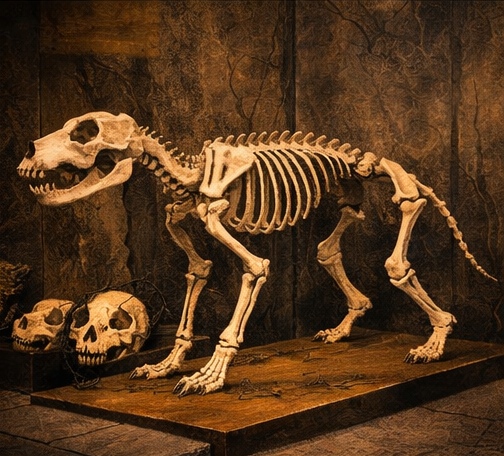
Despite being apex predators, the Pleistocene Wolves eventually disappeared near the end of the last Ice Age. Their extinction was not sudden, but the result of several overlapping pressures that reshaped the world they once dominated.
Climate Change
As the Ice Age drew to a close, global temperatures began to rise. Vast tundras shrank, glaciers retreated, and forests spread across regions that had once been open plains. For wolves adapted to wide, frozen landscapes, this shift was devastating. Their endurance‑based hunting style was less effective in dense forests, where prey could escape into cover.
Declining Prey
The giants of the Ice Age — mammoths, giant bison, and other megafauna — dwindled rapidly. Some species struggled to adapt to warmer climates, while others fell victim to increasing human hunting. With fewer large prey animals available, the Pleistocene Wolf’s specialized hunting strategy became unsustainable.
Competition
Other wolf populations, better suited to forested environments and smaller prey, began to thrive. These wolves competed directly with the Pleistocene Wolf for food and territory. Over time, the more adaptable lineages outlasted their Ice Age cousins.
Hybridization
Some Pleistocene Wolves may have interbred with these surviving wolf populations. While this allowed fragments of their DNA to persist, it also diluted their distinct lineage. In genetic terms, the Pleistocene Wolf vanished into the broader wolf family tree.
Breaking it down
extinction here doesn’t mean their genes disappeared entirely. Instead, the unique population we call the Pleistocene Wolf ceased to exist as a separate group. Their DNA lived on, but their identity as a distinct species was lost.
Genetic Legacy: The Ghost Lineage in Dogs
Modern genetic research reveals a stunning truth: although the Pleistocene Wolf vanished thousands of years ago, its DNA lives on in every dog. Scientists call this a ghost lineage — a species that is physically extinct but genetically preserved within another. In other words, while the wolf itself no longer roams the tundra, fragments of its genetic code survive in the loyal companions curled at our feet today.
The traits inherited from this Ice Age predator are easy to recognize:
- Endurance: Huskies, bred to pull sleds across frozen landscapes, echo the wolf’s stamina.
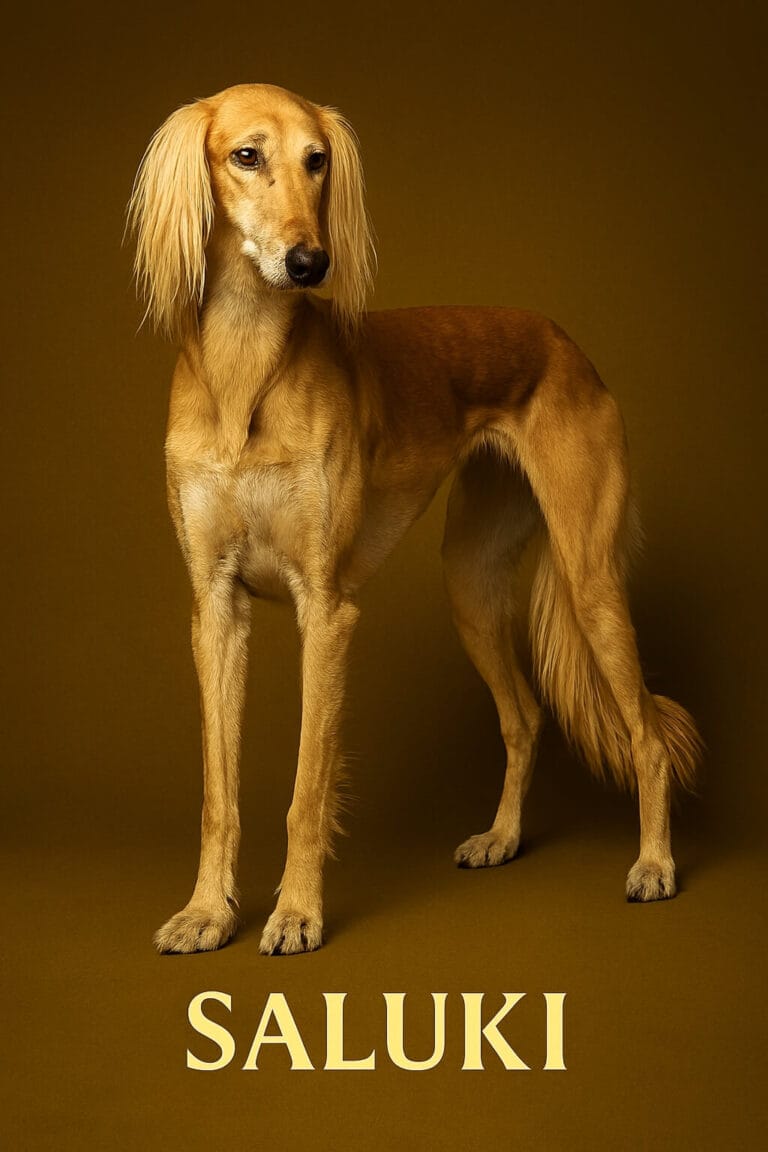
- Speed: Salukis, one of the oldest dog breeds, carry the wolf’s ability to chase prey across open plains.
- Guarding instinct: Mastiffs, powerful protectors, reflect the wolf’s role as a guardian of its pack.
- Adaptability: From desert hunters to Arctic sled dogs, modern breeds mirror the wolf’s ability to thrive in diverse environments.
This genetic legacy makes dogs unique among domesticated animals. Cats, for example, still share DNA with their living ancestor, the African Wildcat. Dogs, however, descend from a lineage that no longer exists in the wild. Every bark, every wagging tail, every moment of loyalty is a living echo of a predator that chose companionship over extinction.
Breaking it down
Ghost lineage means the body of the species is gone, but its genetic “fingerprints” remain inside another living species. Dogs are walking archives of the Pleistocene Wolf.
Fun Fact
Genetic studies show that all dog breeds — from tiny Chihuahuas to giant Great Danes — carry fragments of Pleistocene Wolf DNA, proving that size and shape may differ, but the ancient wolf’s spirit endures in them all.
Recognition and Popularity: Wolves in Human Culture
The wolf’s legacy isn’t only genetic — it’s cultural.
- Norse mythology: Fenrir, the giant wolf destined to battle gods.
- Roman legend: Lupa Capitolina, the she‑wolf who raised Romulus and Remus.
- Native American traditions: Wolves as spirit guides and teachers.
Unlike cats, who were worshipped in Egypt, wolves were feared yet respected — symbols of survival and loyalty.
Cultural Significance: Preserved Through Companionship
Dogs are unique among domesticated animals because they descend from a lineage that vanished entirely. Unlike cats, whose ancestor — the African Wildcat — still prowls deserts and savannas today, dogs trace their roots to the Pleistocene Wolf, a predator that no longer exists in the wild.
This distinction gives dogs a special cultural significance. They are the only domesticated species whose wild ancestor is extinct, meaning their survival as a lineage depended entirely on their bond with humans. Without that partnership, the Pleistocene Wolf would have vanished completely, leaving no trace. Instead, its spirit endures in loyalty, intelligence, and adaptability — qualities that define dogs today.
From sled dogs racing across Arctic snow to guardians protecting homes, every breed carries echoes of the wolf’s resilience. In this way, dogs are more than pets; they are living monuments to an ancient predator that chose companionship over extinction.
Breaking it down
Cats carry living DNA from a species that still survives. Dogs, however, are living archives of a wolf that disappeared thousands of years ago. This makes every dog not just a companion but a genetic time capsule of the Ice Age.
Fun Fact
Archaeologists often describe dogs as “the species that saved itself through humans.” By adapting to human society, they preserved a lineage that would otherwise have been lost forever.
Health and Care: Survival in the Ice Age
In the unforgiving world of the Ice Age, survival was dictated not by human care but by the harsh rhythms of nature. The Pleistocene Wolf’s health and longevity were shaped entirely by its environment, prey availability, and pack dynamics.
Lifespan
Scientists estimate that these wolves lived around 8–12 years in the wild. While this may seem short compared to modern domestic dogs, it was typical for large predators facing constant challenges — from brutal winters to injuries sustained during hunts. In rare cases, wolves that avoided conflict and thrived within strong packs may have lived longer, but survival was never guaranteed.
Diet
The Pleistocene Wolf’s diet was as formidable as its build. It fed primarily on large prey such as bison, reindeer, and even mammoths. Hunting such giants required teamwork and endurance. When prey was scarce, wolves likely scavenged carcasses left behind by humans or other predators, using their powerful jaws to crack bones and access nutrient‑rich marrow.
Threats
Despite being apex predators, they faced significant threats:
- Climate change gradually reshaped their habitats, reducing open tundra.
- Prey decline left them struggling to find food.
- Competition with other wolf lineages and predators increased pressure.
- Human expansion introduced new dangers, as hunters targeted the same prey and sometimes the wolves themselves.
Adaptations
To endure these challenges, the Pleistocene Wolf evolved remarkable adaptations:
- A thick, insulating coat protected against freezing winds.
- An endurance‑based metabolism allowed them to sustain long hunts without collapsing.
- Pack cooperation ensured survival, with wolves relying on social bonds to hunt, defend territory, and care for pups.
Fun Fact
Unlike cats, which are solitary hunters, wolves depended on their pack for survival. This cooperative lifestyle not only kept them alive in the Ice Age but also laid the foundation for their eventual partnership with humans.
Practical Guide: Legacy in Modern Dogs
Although the Pleistocene Wolf itself vanished thousands of years ago, its traits live on in every dog today. These qualities are not just echoes of the past — they are practical features that shape how dogs interact with humans and thrive in modern environments.
Loyalty to Social Groups
Like their wolf ancestors, dogs are deeply social animals. Wolves depended on their packs for survival, and this instinct translated into the loyalty dogs show toward their human families. Whether guarding a home or curling up beside a loved one, dogs carry the wolf’s devotion to its group.
Intelligence and Problem‑Solving
Surviving the Ice Age required sharp minds. Wolves had to track prey across vast tundras, anticipate movements, and cooperate during hunts. Modern dogs inherit this intelligence, which is why they excel in tasks ranging from herding livestock to assisting in search‑and‑rescue missions.
Communication Skills
Wolves developed complex communication systems — body language, vocalizations, and subtle cues — to coordinate within their packs. Dogs inherited this ability and adapted it to bond with humans. Their uncanny skill at reading human emotions, gestures, and tone of voice is a direct legacy of wolf communication.
Adaptability Across Climates
The Pleistocene Wolf thrived in extreme cold, but its descendants proved adaptable to deserts, forests, and urban environments. Today, dogs live everywhere from Arctic villages to tropical cities, reflecting the wolf’s remarkable ecological flexibility.
Fun Fact
Studies show that dogs are more attuned to human social cues than even chimpanzees, our closest primate relatives. This unique ability is a gift from their wolf ancestors, who learned to cooperate not only with their packs but eventually with humans.
Quick Facts: The Pleistocene Wolf
For readers who want the essentials at a glance, here are the key details about the wolf that lives on only in dogs:
- Scientific Context: The Pleistocene Wolf was an extinct Ice Age wolf lineage, genetically distinct from modern Gray Wolves.
- Time Period: It thrived during the Pleistocene Epoch (2.6 million–11,700 years ago), a time when glaciers dominated the Northern Hemisphere.
- Habitat: These wolves roamed the Eurasian tundra and steppe, vast open landscapes where endurance hunting was possible.
- Prey: Their diet included mammoths, giant bison, and reindeer, making them apex predators of the Ice Age.
- Size: Estimated at 40–60 kilograms (90–130 pounds), they were similar to or larger than modern wolves, with long legs built for stamina.
- Status: The lineage is extinct, disappearing near the end of the Ice Age due to climate change, prey decline, and competition.
- Legacy: Despite extinction, they remain the direct ancestor of all domestic dogs, preserved as a ghost lineage in canine DNA.
Fun Fact
Every dog breed alive today — from tiny Chihuahuas to massive Great Danes — carries fragments of Pleistocene Wolf DNA, proving that this Ice Age predator never truly vanished.
Conclusion: The Wolf That Lives On
Though the Pleistocene Wolf vanished thousands of years ago, its legacy endures in every dog that walks beside us today. Every wagging tail, loyal gaze, and joyful bark carries the spirit of an Ice Age hunter that once roamed frozen tundras alongside humans.
In a world where countless species have disappeared forever, the Pleistocene Wolf achieved something remarkable. It did not vanish completely — instead, it transformed. By adapting to human society, it preserved its lineage in a new form: the domestic dog. What was once a predator of mammoths and bison became humanity’s most faithful companion, guarding homes, pulling sleds, and offering unconditional loyalty.
This story is more than natural history; it is a testament to survival through partnership. The wolf’s body may be gone, but its DNA, instincts, and spirit live on in every breed, from the smallest lapdog to the largest guardian. Dogs are not just pets — they are living monuments to an ancestor that chose companionship over extinction.
Final Word
Every bark is an echo of the Ice Age. Every pawprint is a reminder of the tundra. And every dog, no matter its size or shape, carries within it the heartbeat of the Pleistocene Wolf — the predator that became a partner, the hunter that became a friend.
External Sources:
- Wikipedia
- Wiley Online Library – Pleistocene Sicilian Wolf Populations
- Springer – Fossil Wolf with Preserved Soft Tissue
Read our Other Blogs
Rottweiler Secrets of the History to Modern Time
Credit
A big thank you to Microsoft for the images provided